Weddings are moving into Jordan's cultural sites
From an engagement inside the Amman Citadel to weddings in Little Petra and Qasr Al-Mshatta, couples are placing their private celebrations inside Jordan's public history.
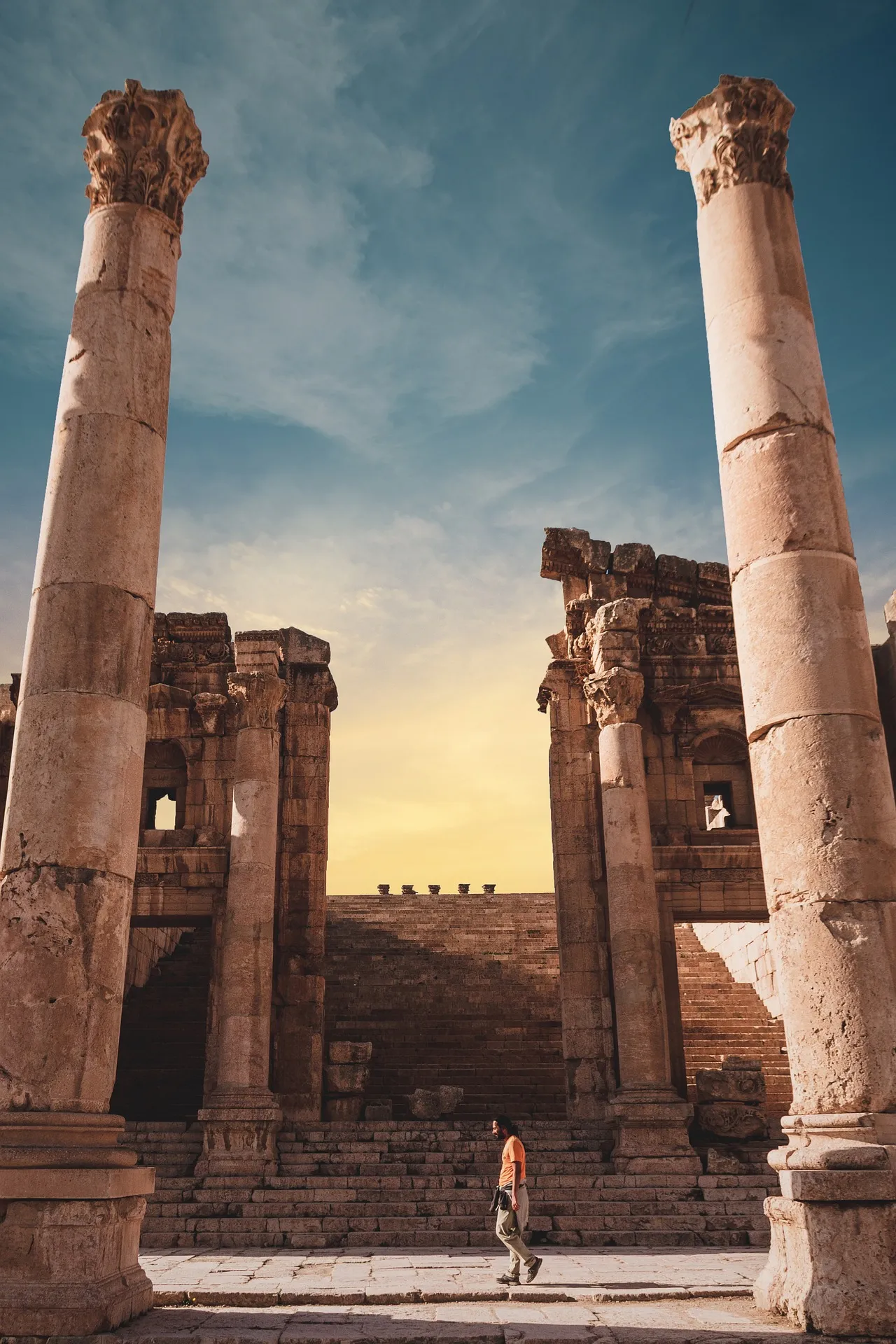
A wedding photograph rarely remains within the wedding.
It moves from the couple’s account to their guests, from the photographer to the planner, and from there to wedding publications, mood boards and the feeds of people who may never have considered Jordan before. The couple is the subject of the image. The location is often what makes someone stop.
Recently, an engagement took place inside the Umayyad Palace at the Amman Citadel. A couple held their pre-wedding celebration beneath the columns of the Temple of Artemis in Jerash. Weddings appeared among the stone arches of Qasr Al-Mshatta and within the Nabataean landscape of Little Petra.
Different couples, different celebrations. Together, they are the clearest public result of a sector that Jordan’s tourism institutions have been quietly developing for at least two years, and they are arriving precisely when Jordan needs them most.
The timing is not incidental
According to the Central Bank of Jordan, international arrivals to Jordan fell 5% to 2.01 million in the first four months of 2026. Tourism revenues fell harder: $2.17 billion, down 10.4% on the same period in 2025. April alone was down 27.2%. The decline ran across every source market, with American visitors down 17.1%.
Jordan’s visitor economy is unusually exposed to how the region looks from the outside. The country can be entirely calm and still lose a season to headlines written about its neighbours.
That exposure is why the type of tourism Jordan attracts matters just as much as visitor numbers. Roughly 85% of international visitors come for culture and heritage, according to the National Tourism Strategy 2021-2025. This model depends on large numbers of visitors who spend relatively little, peaks during certain seasons and is often the first to suffer when the region feels uncertain.
A destination wedding behaves almost nothing like it. That difference is the argument. Jordan doesn’t need more visitors. It needs visitors who are worth more.
What one wedding brings
According to The Knot, 83% of couples who plan a destination wedding say their guests must travel or stay overnight, and guests who fly spend an average of $1,680 each. The couple themselves spend an average of $41,000 on an international destination wedding.
For a wedding of sixty guests flying in, that could mean around $100,000 on travel and accommodation alone. Add the couple’s wedding budget, and a single celebration could bring well over $140,000 into the wider tourism and events economy.
More importantly, that money lands differently. A packaged tour distributes value to airlines, hotels and operators. A site-led wedding distributes it to florists, set designers, photographers, caterers, fashion designers and make-up artists - that is, to skilled creative labour, most of it Jordanian, much of it freelance, and a significant share of it women.
And there is the calendar. Jordan’s heritage tourism is seasonal by nature. Weddings run on a different clock - Four Seasons Amman reports its strongest demand from couples in the Gulf and India booking June through September, traditionally the quietest period for cultural tourism. Wedding demand fills the months when tourism slows down.
This is already a sector, not a trend
The strongest evidence that this is an economic proposition rather than an aesthetic one is that the institutions moved first.
In October 2025, Aqaba hosted the 11th Destination Wedding Planners Congress - the industry’s largest B2B gathering, bringing more than 500 planners from over 70 countries. It was brought to Jordan by the Aqaba Special Economic Zone Authority in partnership with the Jordan Tourism Board, and it placed Jordan on a host list that includes Athens, Florence, Bali, and Dubai. The Jordan Tourism Board’s Managing Director, Dr Abdulrazzaq Arabiyat, put it plainly: “Wedding tourism is one of the key sectors supporting the tourism industry and the national economy.”
Then the hospitality industry made it bookable. In 2025, Four Seasons Hotel Amman began selling fully coordinated weddings staged away from the hotel at two archaeological locations: the Amman Citadel, and the South Theatre at Jerash. Not a hotel ballroom overlooking these sites, but within the sites themselves.
When a global luxury hotel begins offering a Roman theatre as a ceremony venue, complete with catering, lighting and production, the heritage site is no longer simply a setting chosen by an individual couple. It has become part of Jordan’s luxury wedding market.
Why the images work harder than a campaign
Conventional destination marketing presents archaeological sites as empty landscapes. The Treasury without visitors. Wadi Rum without movement. Jerash silent beneath the sun. Those images do not tell you what it would feel like to be there, and they feel more like advertisements than lived experiences.
Wedding images do something a tourism board cannot do for itself. They give the landscape an emotional function, and they do it through someone else’s story.
Petra becomes somewhere to make a promise. Jerash becomes somewhere to gather. The Citadel becomes part of a family’s story - at Farah Hanandeh’s engagement, the family described choosing the Umayyad Palace deliberately, to show that “local is more beautiful” and that Jordan has archaeological sites it can proudly present to the world. Little Petra becomes the place where two cultures begin a shared life, as it did this month for Lila Refai and Guilherme Dzik, whose wedding was described as bringing two worlds together beneath the Petra landscape.
The site stops being observed. It participates.
That matters because of how destination choices are now made. Expedia’s 2026 research, surveying 24,000 adults across 18 countries, found that 81% of Gen Z and millennial travellers plan trips around locations they have seen on screen. Screen content and social content are not identical, but they work on the same mechanism: a place enters the imagination through a story someone else was telling, and it stays there. No campaign pays for that reach, and it returns every anniversary.
Fashion understood this before tourism did. When Dior staged a men’s show at the Pyramids of Giza in December 2022, Egypt’s former vice-minister of tourism, Adla Ragab, described the return in exactly these terms: “free publicity with all the influencers and bloggers,” with an impact “like a snowball effect where people will start talking about everywhere.”
Notably, she could not point to a number.
No carousel, however widely shared, can be credited with an increase in visitor numbers. The data required to prove it - search interest, booking origin and enquiry attribution, tracked against publication - is not collected in Jordan, and the Egyptian example shows that even a globally covered event leaves officials describing impact rather than measuring it.
What these images create comes before the booking itself; awareness, imagination, desire. Before anyone books a destination, they have to be able to picture themselves in it.
Sources
- Tourism revenue at $2.17 billion amid regional challenges (opens in a new tab)Jordan News Agency, 2026
- JORDAN NATIONAL TOURISM STRATEGY 2021 - 2025 (opens in a new tab)Ministry of Tourism and Antiquities
- Four Seasons Makes History with Destination Weddings in Amman (opens in a new tab)Four Seasons, 2025
- Aqaba to host the world’s biggest B2B congress for destination weddings (opens in a new tab)The Jordan Times, 2025
- Magical Nighttime Ceremony in Front of the Ancient Petra Treasury (opens in a new tab)green wedding shoes, 2020
- Expedia predicts Set-Jetting surge: Gen Z and Millennials drive screen-inspired tourism in 2026 (opens in a new tab)Expedia, 2025
- Here's the Average Wedding Guest Cost and How to Budget for It (opens in a new tab)The Knot, 2026
- The Average Cost of a Destination Wedding, According to Our Data (opens in a new tab)The Knot, 2025
- Here Is How Dior’s Runway Show Is Impacting Egypt’s Tourism (opens in a new tab)Business Monthly Egypt, 2022